






 Trap
 Normal
Appointer of the Red Lotus
View:
1041
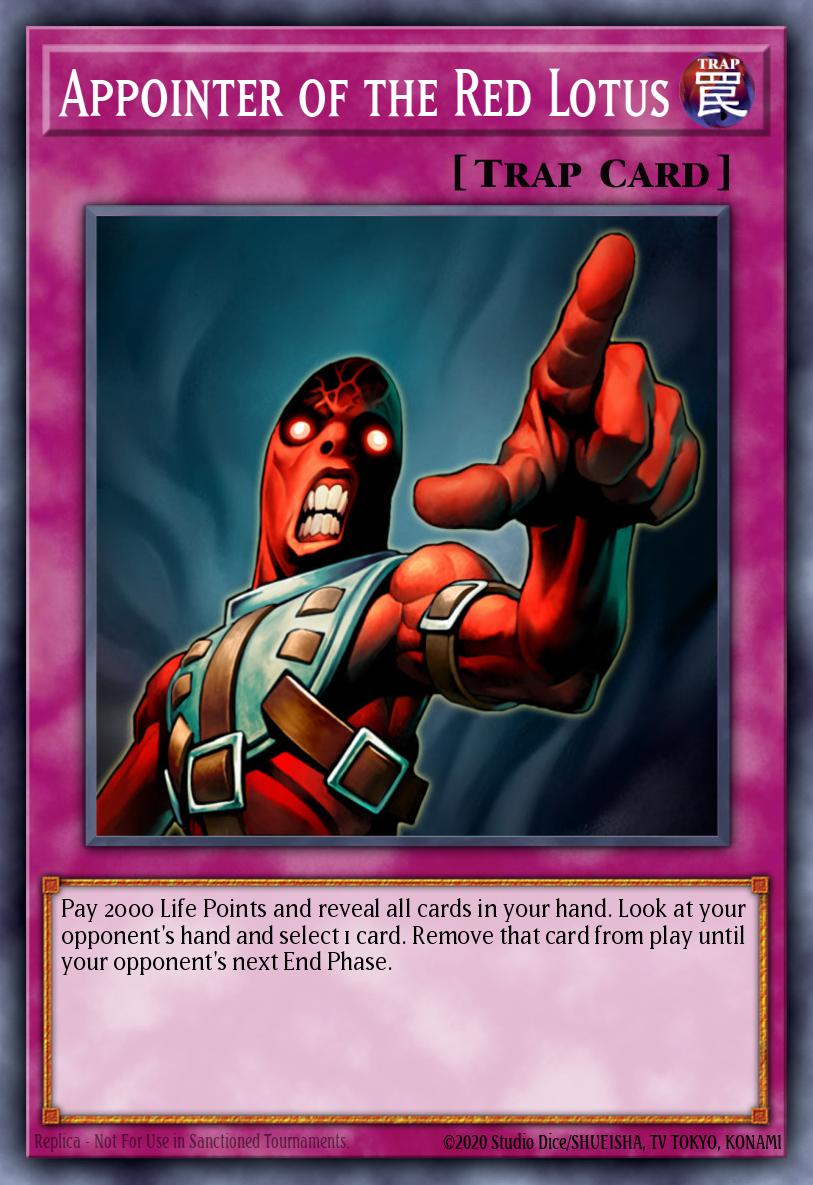
Pay 2000 Life Points and reveal all cards in your hand. Look at your opponent's hand and select 1 card. Remove that card from play until your opponent's next End Phase.


Appointer of the Red Lotus — Power Evaluation
Final Score: 52 ± 7 · Confidence: Medium
- Intrinsic: 50 · Deck: 54 · Meta: provisional
- Primary role: Removal / Negation · Secondary: Utility
Why it scores here
Appointer of the Red Lotus is a Trap that costs 2000 LP to reveal your hand, look at the opponent's hand, and banish one card they hold until their next End Phase. Its value is a single, temporary, targeted disruption, scored under the removal/negation profile. The 400-deck sample (98 archetypes, 1.4 average copies) confirms it is a practical, cheap staple, but that frequency only moves accessibility and deck resilience, not the score. The card scores modestly because it cannot convert anything on its own, gives no card advantage, costs life points, and has no material body; the high spread of decks does not earn it points on its own.
Axis scores
| Axis | Score | Evidence |
|---|---|---|
| Accessibility | 45 | It is a set Trap, so it is not live in the opening hand and needs a set turn; it is still run in 400 of 400 sampled decks at 1.4 copies on average (verified from deck stats; activation timing is inferred from the Trap type). |
| Combo & Conversion | 15 | It builds nothing: its only effect is a reveal and a banish, and there are zero recorded combos or starter/payoff appearances (verified: combo data is empty). |
| Resource Economy | 30 | It is a one-for-one, temporary banish and costs 2000 LP with no draw, search or refuel (verified from card text). |
| Effect & Interaction | 58 | It gives targeted removal of one chosen card from the opponent's hand plus full hand information, but the banish is temporary and the card is not a flexible negation (verified from card text; the Dark Magician guide only mentions it as a tech). |
| Material Utility | 5 | It is a Trap and cannot be used as monster material, so the axis is near zero (verified from card type). |
| Resilience & Flexibility | 40 | Its effect expires at the opponent's next End Phase and depends on being set; there is no recursion or redundancy line in the evidence (inferred from card text). |
| Deck-Building Efficiency | 70 | It is a one-copy-type slot with no garnet or lock restriction; the cost is 2000 LP rather than card slots (verified from card text and copy distribution). |
Calculation
Weight profile: 0.7 Removal/Negation + 0.3 Utility (blend). Intrinsic ≈ 50, Deck ≈ 54, Meta = provisional. Modifiers: none. Final formula: 0.40*Intrinsic + 0.60*Deck
Strengths
- Reveals the opponent's hand and banishes a chosen card, so it is flexible across hand states
- Cheap to include: one copy is the norm and there are no garnet or lock restrictions
- Broadly played: appears in 98 distinct archetypes in the sample, so it is portable across homes
Weaknesses
- Costs 2000 LP, a real cost for a single temporary banish
- Needs to be set, so it is not live from the opening hand
- No card advantage, search, or board presence; it cannot build anything
- The banish expires at the opponent's next End Phase, so the disruption is temporary
Counters / choke points
- Trap-negation or set-zone disruption, which is inferred from the Trap type (not measured in the evidence)
Best use
Hand disruption / tech slot. Decks: Dark Magician (guide tech), Broad staple slot across the 98 archetypes in the sample. Suggested copies: 1.
Evidence & gaps
- Verified: Card type is Trap; effect costs 2000 LP, reveals own hand, views opponent's hand, and banishes one chosen card until the opponent's next End Phase; Present in 400 of 400 sampled decks at 1.4 average copies across 98 archetypes; Zero recorded combo appearances
- Observed: Top partners include Maxx "C" (98.5%), Droll & Lock Bird (98.2%) and Ash Blossom & Joyous Spring (96%); Usage statistics show 66.7% inclusion in the Watt archetype (single archetype record)
- Inferred: Primary role is hand disruption / removal, based on the banish effect; Must be set before it can be activated, based on the Trap card type; Its disruption is temporary and playable around by an opponent who knows the target
- Data gaps: No recorded combos, so combo conversion is text-only inference No rulings or activation-timing text beyond card type Usage statistics cover only one archetype (Watt); no broader historical sample to confirm consistency Deck inclusion is 400 of 400 in the sample, which may reflect how the sample was built rather than true meta penetration Race is listed as Normal, which does not affect the evaluation but is unusual for a Trap